Dentistry / AI / Visual thinking

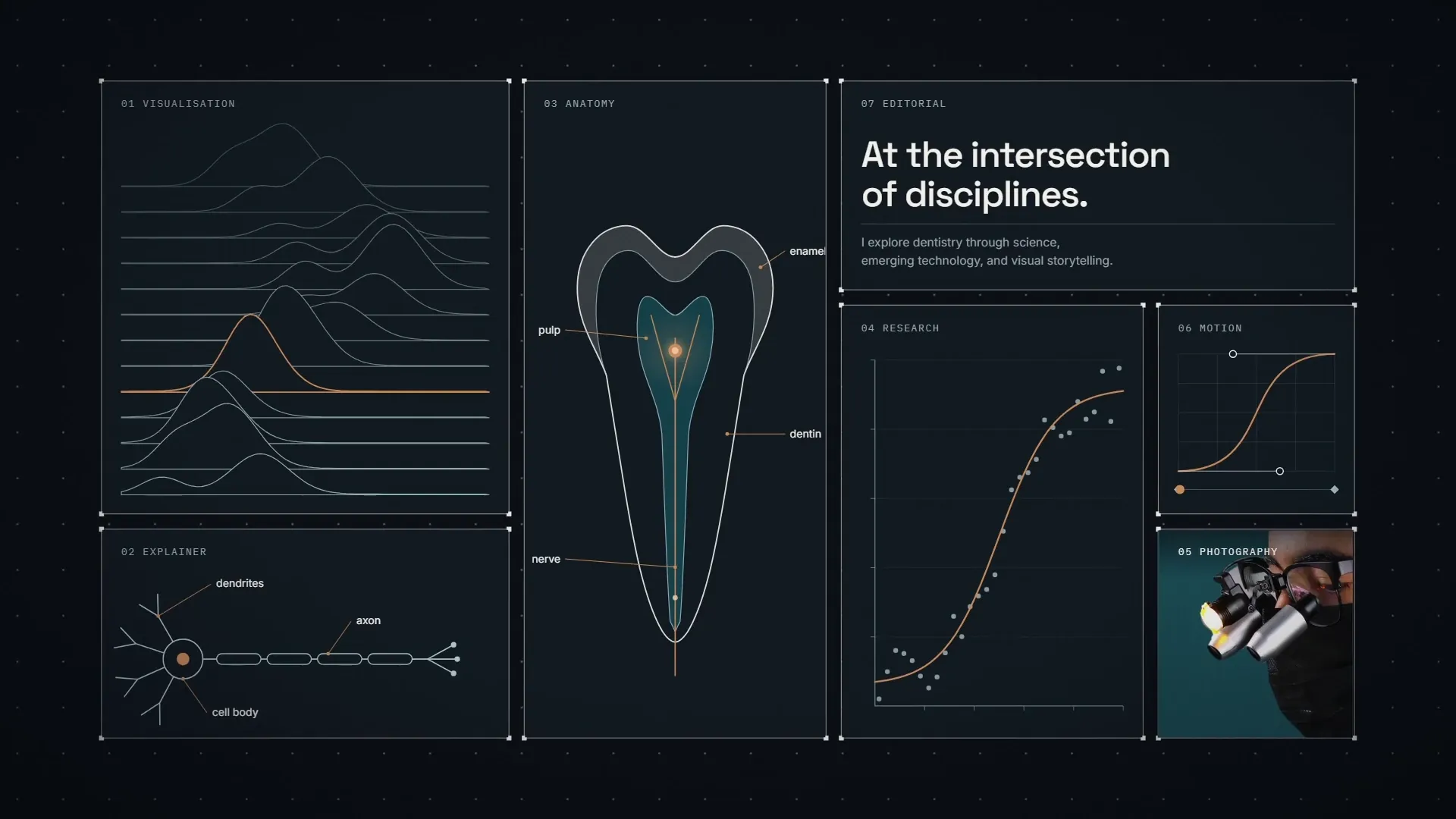
At the intersection of disciplines.

I explore dentistry through science, emerging technology, and visual storytelling.

00 — The nourdents manifesto

Different disciplines. Connected perspectives.

A visual exploration of the thinking behind nourdents — where dentistry, science, technology, and visual storytelling meet.

A nourdents original film0:44 · 16:9 · Sound

A 45-second film in one continuous shot, with an original soundtrack and no narration: a point of light becomes a line, a lamp, a name, the wordmark’s full stop, a cell, a working neuron, a network, an inkblot, an artificial network, a layout, a board of work, and the full stop again.

01 — Selected clinical work

Clinical work, documented step by step.

Selected cases from my practice. Written accounts of the reasoning, materials and limitations are being added to each case.
  1. 01 / RehabilitationQuadrant Rehab
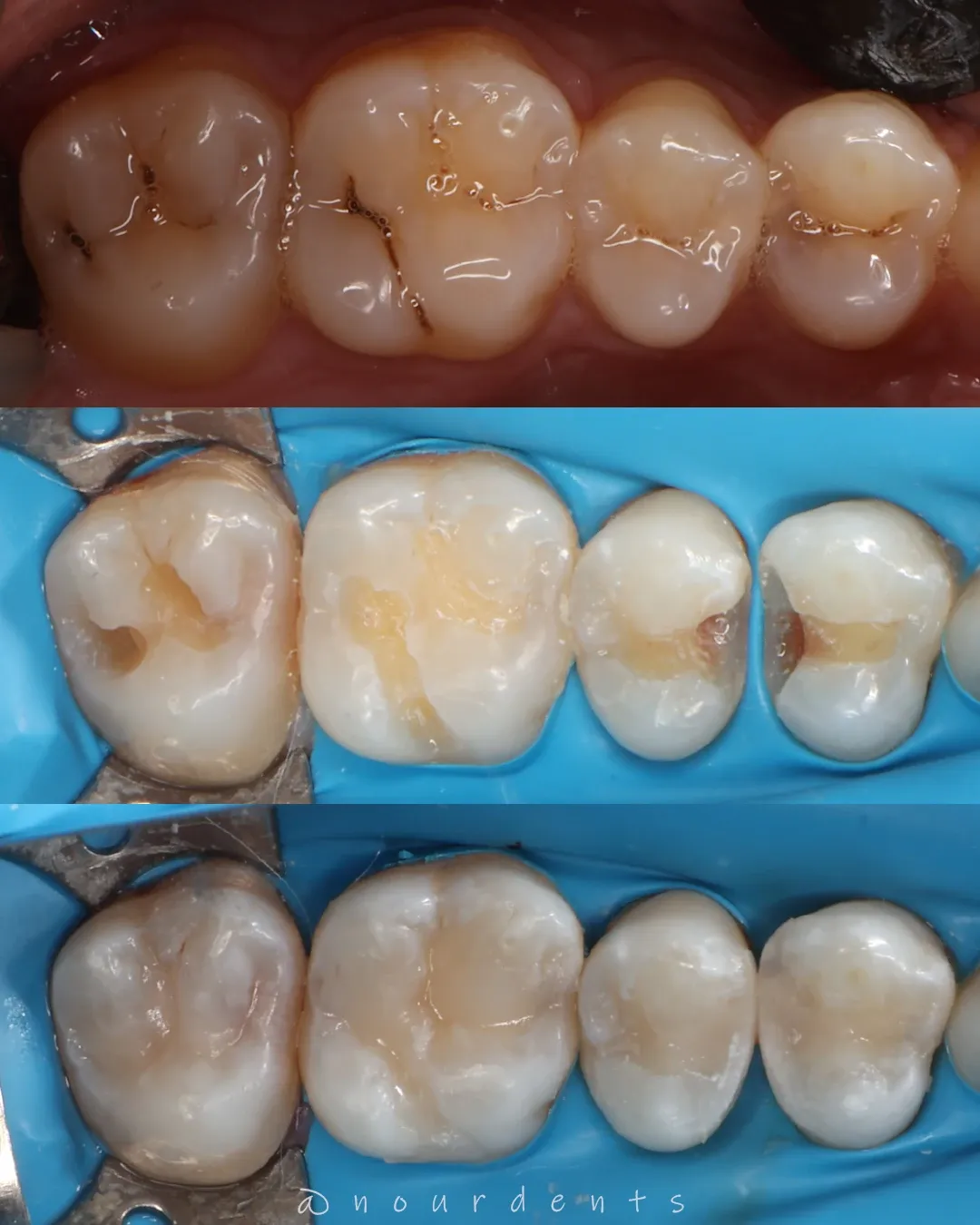
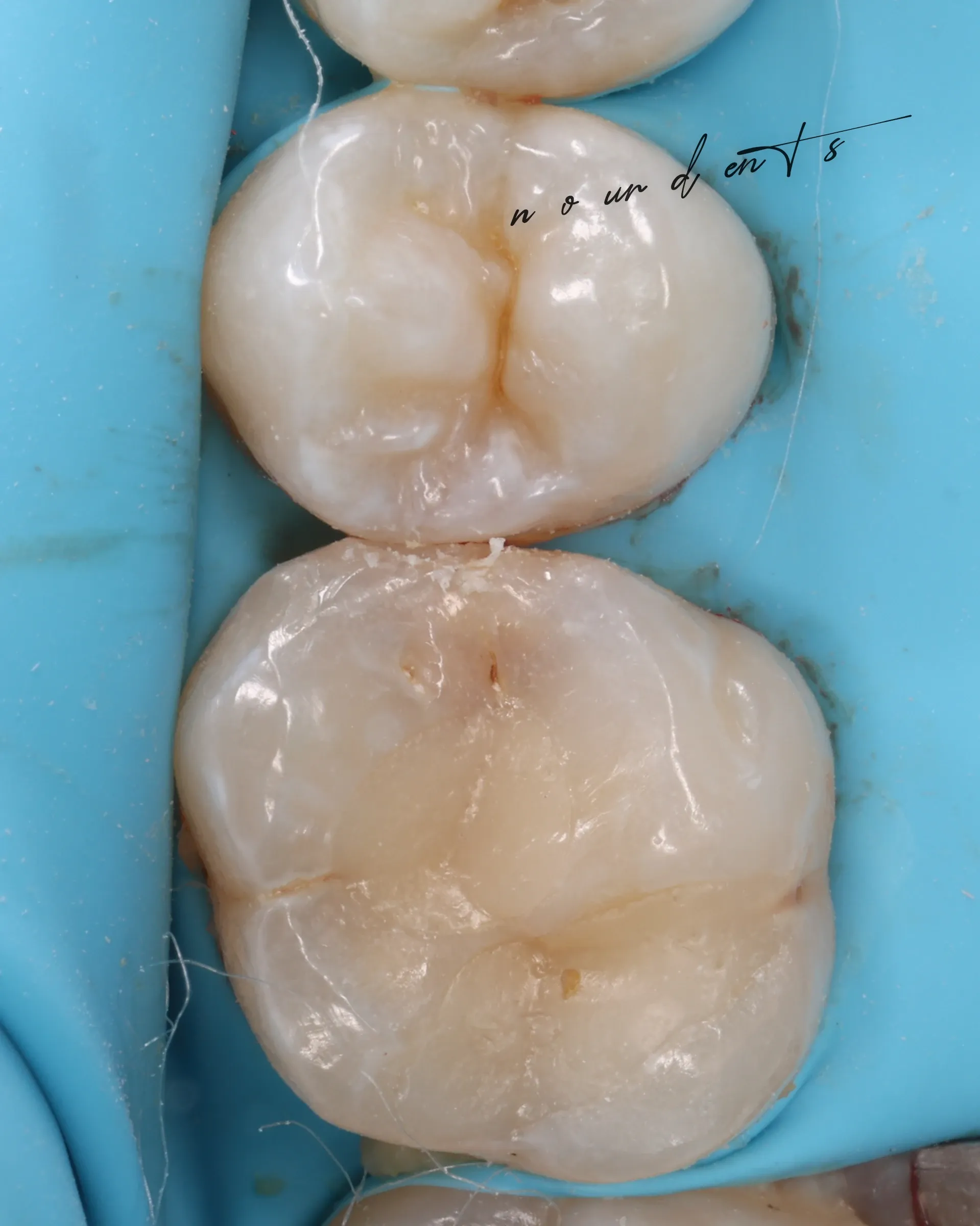
  2. 02 / RestorativeBack 2 Back Resto
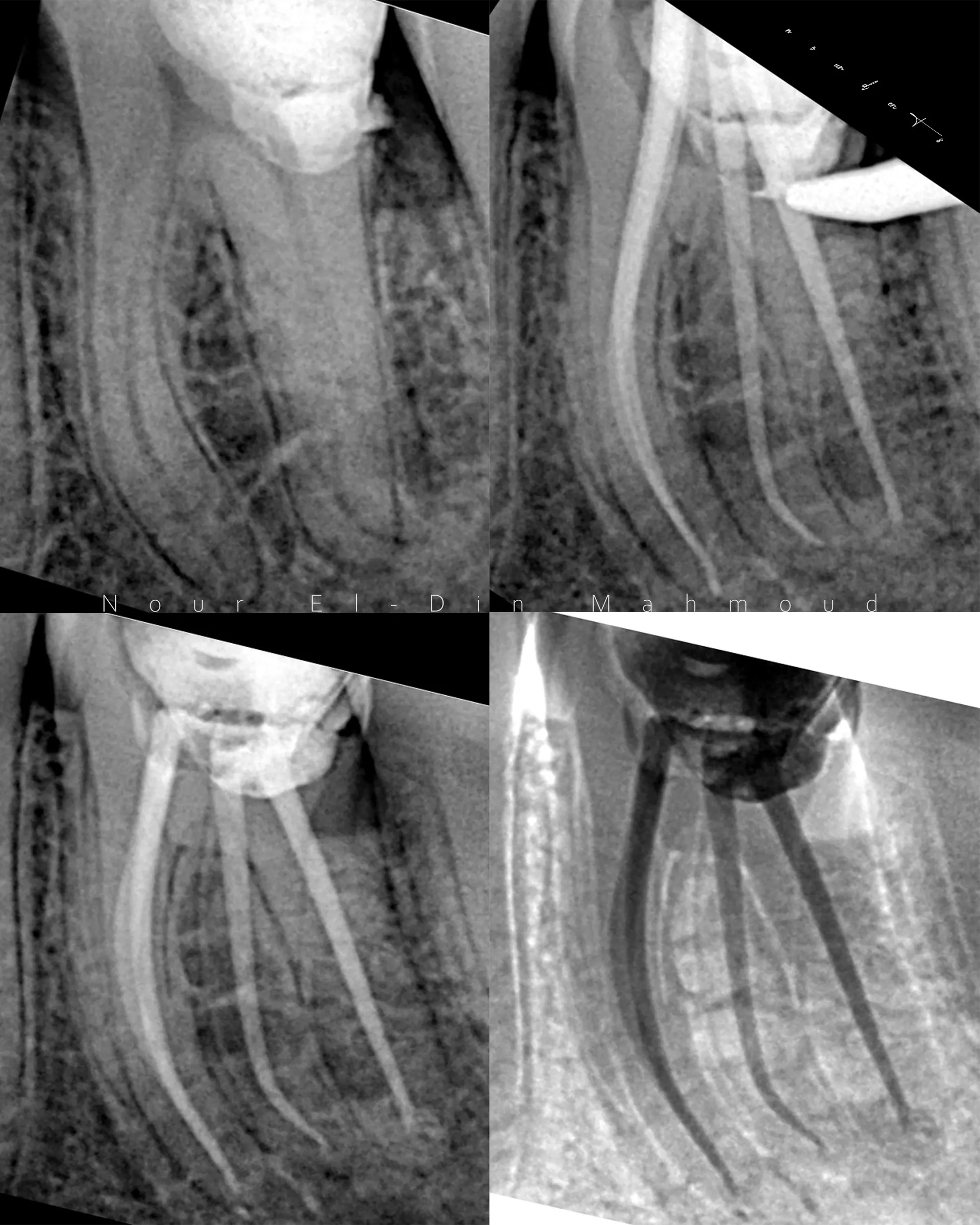
  3. 03 / EndodonticsEndo TTT - Tooth No. 36

Browse all clinical work

02 — Dental Hacks

Clinical Hacks, Backed by Biomechanics.

Bridging laboratory literature with chairside reality through kinetic motion, fluid dynamics, and zero cognitive friction.

75 s · no voice-over · programmatic motion in Remotion, coded with AI assistance

Hack #01 • Class I Restorations

The Class I Paradox

  • [ C-Factor = 5:1 ]
  • [ Hydrodynamic Shock ]
  • [ Decoupling with Time ]
  • [ Unterbrink 1999 ]

The clinical question

“Why does the smallest Class I restoration trigger severe bite sensitivity while a large Class II remains painless?”

  1. 01 The Fluid Trap

    Water is not compressible. Complete debonding lets the fluid escape; localized debonding seals a micro-void where masticatory load drives hydrodynamic shock down open dentinal tubules.

  2. 02 Faster Beats Stronger

    In the paper’s hypothetical Fig 1, DBA 1 reaches 20 MPa in a 1-hour lab test. Inside a cavity, shrinkage stress outpaces its bond within the first 10 minutes, so its clinical bond strength “would be zero.”

  3. 03 The Protocol: Resin Coating & IDS

    Enamel reaches 30 MPa in about 3 min, superficial dentin up to 50 MPa in 5 min, and deep dentin needs up to 30 min to reach 40 MPa. An air-thinned 10 µm adhesive film suffers oxygen inhibition; a thin filled flowable on top (resin coating) protects the hybrid layer and decouples maturation from restorative stress.

View the 1999 Unterbrink study notes & graph
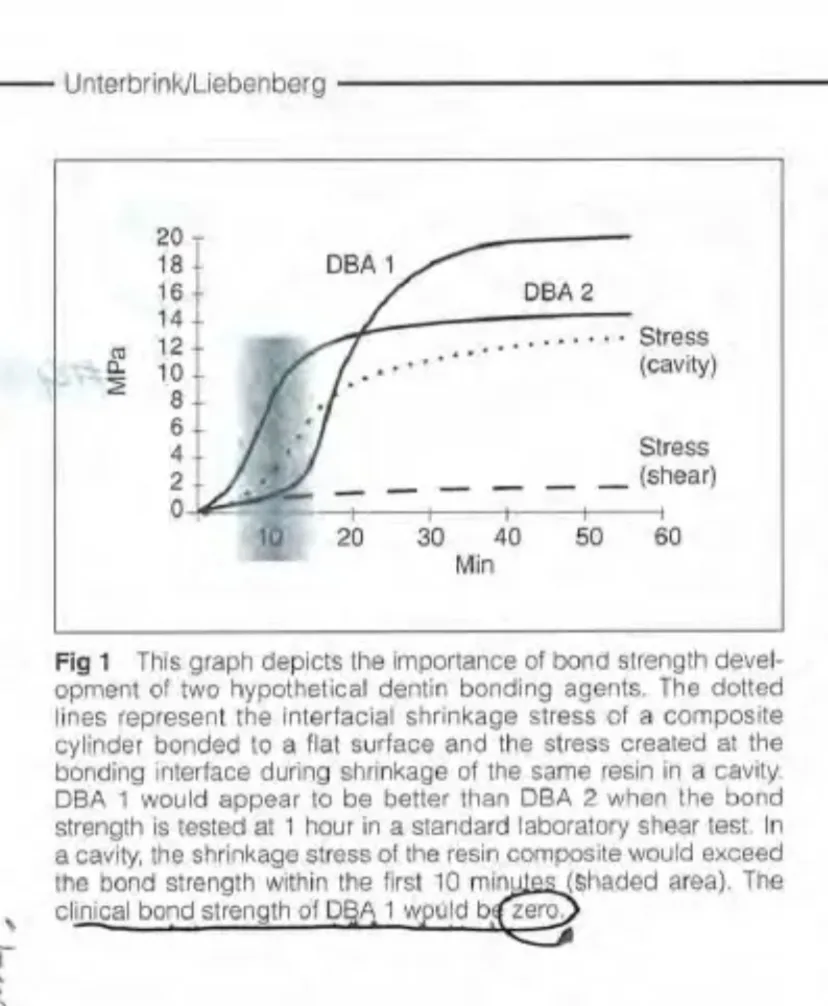
Fig 1 from Unterbrink and Liebenberg, 1999: bond strength in MPa over 60 minutes for two hypothetical dentin bonding agents. DBA 1 rises late but reaches about 20 MPa; DBA 2 rises early and levels off near 14 MPa. A dotted cavity-stress curve rises above DBA 1 during the shaded first ten minutes; a dashed flat-shear stress line stays near 2 MPa. The caption is underlined by hand and the word zero is circled.
Fig 1 with my annotations. Unterbrink GL, Liebenberg WH. Flowable resin composites as “filled adhesives”: literature review and clinical recommendations. Quintessence Int 1999;30:249–257.

The paper’s key line

“To function clinically, bond strength must develop more quickly than the shrinkage stress.”

Hierarchy of bondability · my notes

Time for each substrate to reach its bond strength
SubstrateTimeBond
Enamel3 min30 MPa
Superficial dentin5 minup to 50 MPa
Deep dentin30 minup to 40 MPa

C-factor · Class I

Five bonded walls, one free surface: C = 5 ÷ 1. The resin has only the occlusal surface to flow from while it shrinks.

Study notes for education, not a treatment protocol. Clinical decisions depend on the individual case.

03 — Studio

Motion, design and visual explanation.

Motion graphics, animation and educational media. Select a piece to watch it with sound.

View all 7 motion pieces

04 — Approach

Dentistry is the foundation. Technology and visual thinking are how I extend it.

The site documents that crossing honestly: clinical work with its reasoning and limits, experiments with what failed, and visual work that tries to make ideas clearer.